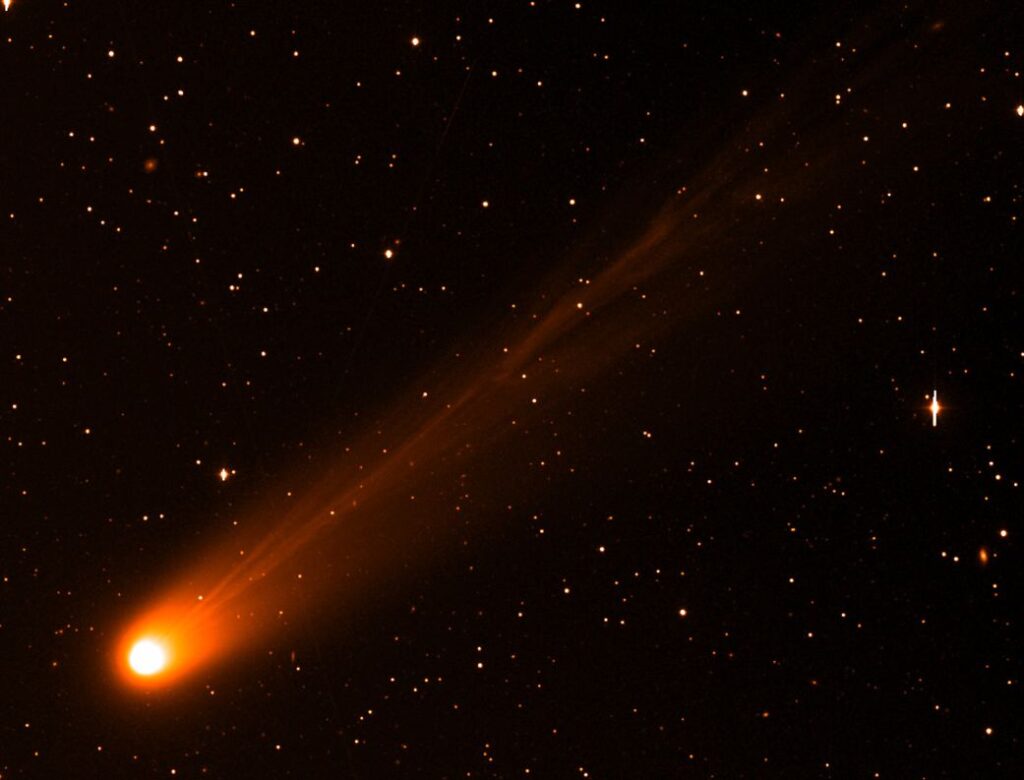
Two newly discovered comets are streaking across the sky in a spectacular display as they make their closest approaches to Earth this month.
Comets are made of ice, frozen gases and rock, and as they travel near stars such as the sun, heat causes them to release gas and dust, which creates their signature tails.
Researchers spotted the comet C/2025 A6 Lemmon January 3, while C/2025 R2 SWAN was only recently detected for the first time on September 10 during its close approach to the sun, according to Qicheng Zhang, a postdoctoral fellow studying small body astronomy at Lowell Observatory in Flagstaff, Arizona.
For eager sky-gazers, it’s a great time now to spot the comets with binoculars or telescopes because they both have long-period, oval-shaped orbits that take them around the sun, meaning they’ll only be in proximity of Earth for a limited time.
Comet SWAN won’t reappear for another 650 to 700 years, while Lemmon will remain out of sight for 1,300 years, said Carrie Holt, postdoctoral fellow and astronomer at Las Cumbres Observatory, a global network of observatories.
Continue reading the complete article on the original source