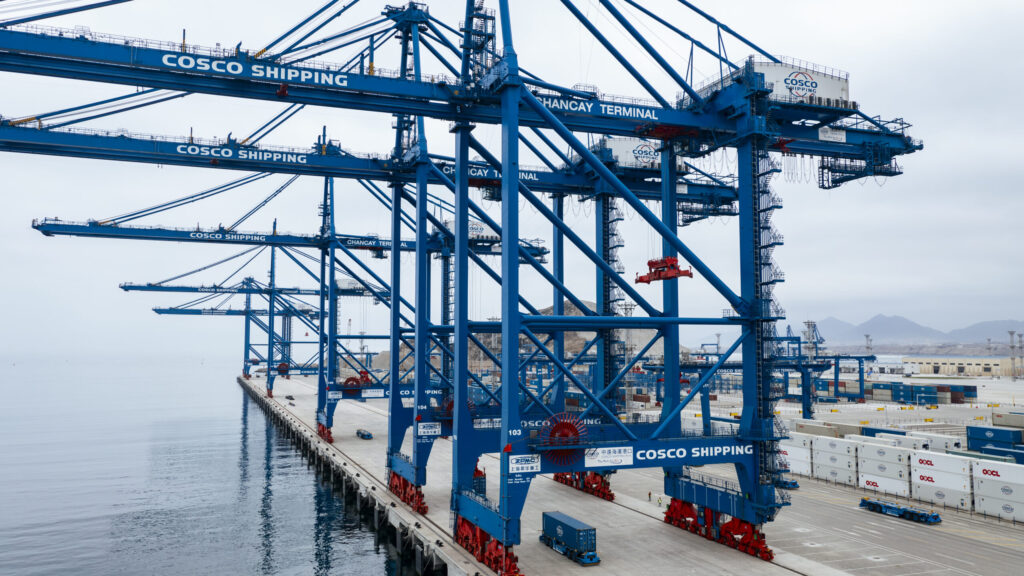
CHANCAY, Peru—The elevator doors leading to the fifth-floor control center open like stage curtains onto a theater-sized screen. This “Operations Productivity Dashboard” instantaneously displays a battery of data: vehicle locations, shipping times, entry times, loading data, unloading data, efficiency statistics. Most striking, though, are the bold lines arcing over the dashboard’s deep-blue Pacific—digital streaks illustrating the routes that lead thousands of miles across the ocean, from this unassuming city, to Asia’s biggest ports. Chancay sits at a curve along the ocean, about 50 miles north of Lima. Until recently, it was best known for its medieval-themed amusement park, a crescent of beach, and a row of seaside restaurants. Now it’s home to South America’s newest, most technologically advanced deepwater megaport and the epicenter of China’s bid to control the flow of goods to and from this commodity-rich continent. For Peru, the recent opening of the port here was the realization, nearly two decades in the making, of a dream to position itself as South America’s global transportation hub, the continent’s primary launching point for a straight shot across the Pacific to Asia’s biggest economies. For China, the port delivers a strategically direct route for the critical minerals and agricultural commodities coming off the continent, and in the other direction, a more expedient channel for its cars, machinery, and electronics to stream into South American markets. The port represents Peru’s first project under the banner of China’s Belt and Road Initiative, Beijing’s $1.3 trillion bid to remake how the world travels and trades, and collectively speaking, the most ambitious infrastructure project in history. It is China’s flagship infrastructure investment in South America—and a crucial node in Beijing’s global strategy for securing access to critical commodities.
Continue reading the complete article on the original source