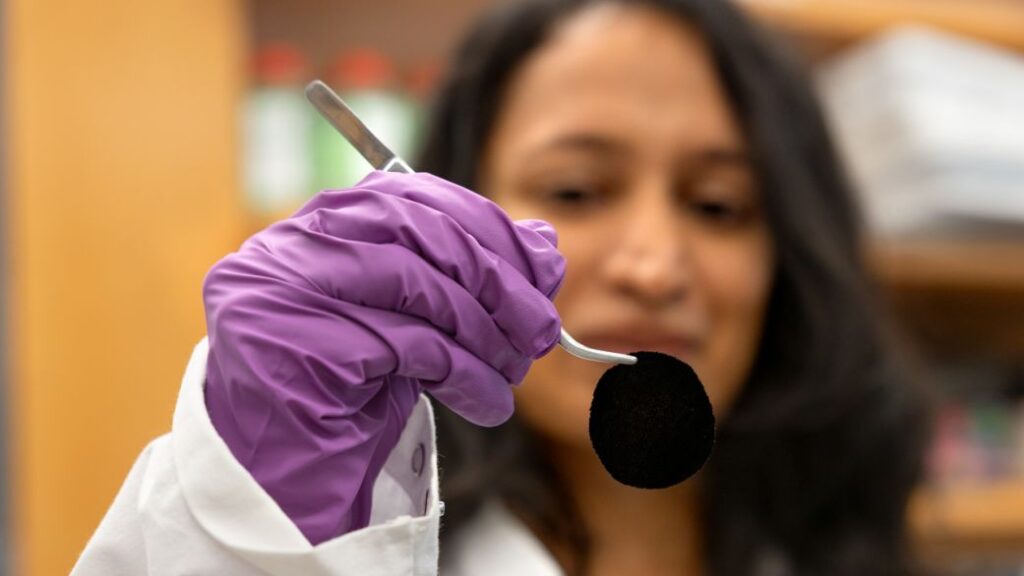
A new fabric inspired by the feathers of the magnificent riflebird — a bird of paradise from New Guinea and the northern tip of Australia — is the darkest ever created, according to its inventors.
Made from white merino wool, the fabric is first dyed with polydopamine, a synthetic form of melanin, the natural pigment that gives color to skin, hair and eyes. It is then etched in a plasma chamber to create microscopic, spiky structures called “nanofibrils,” which trap light very effectively.
The result is a material that absorbs 99.87% of light: “I’ve had professors come in when we were working on this, and they went, ‘It’s like looking at a black hole,’” said Larissa Shepherd, an assistant professor in the Department of Human Centered Design at Cornell University in New York, and senior author of a study about the new fabric, published in the journal Nature Communications.
The researchers created a single prototype dress with the fabric, which includes a visual callback to the plumage of the riflebird itself. They have also filed a provisional patent for the material: “We’re currently working on some potential applications that we’re hoping to publish soon, but one area that I definitely see this with its current properties is high-end fashion,” said Shepherd.
The fabric belongs to a category of materials called “ultrablack,” which typically reflect less than 0.5% of light. The most famous of these materials is Vantablack, which is not a fabric but a coating, created in 2014 and made of microscopic filaments of carbon that absorbs up to 99.97% of visible light. It is used primarily in advanced optics found in telescopes and cameras, but also in luxury goods and artworks.
Continue reading the complete article on the original source