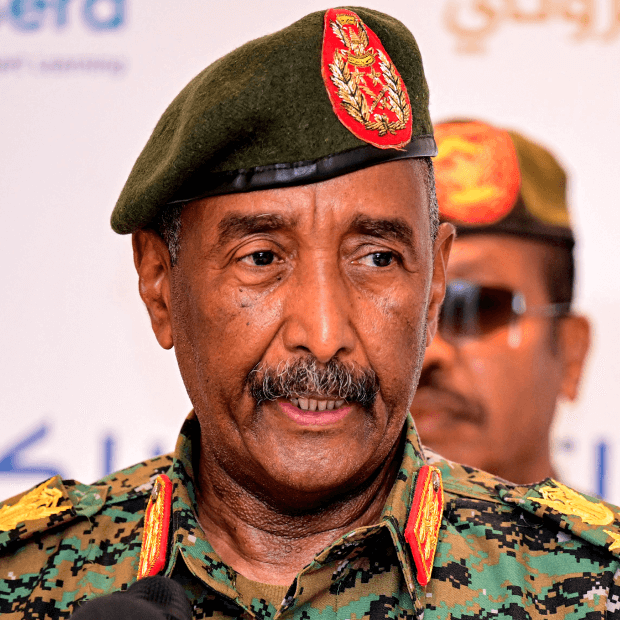
The horrors of Sudan's civil war are only intensifying, with an unimaginable human cost. More than 150,000 civilians are thought to have been killed, almost 12 million people have been forcibly displaced and multiple areas are beset by famine.Fighting between the Sudanese Armed Forces (SAF) and the rebel Rapid Support Forces (RSF) for control of the country has raged since April 2023, and atrocities committed by the RSF appear to have reached new extremes in recent weeks, with an apparent massacre in the city of El Fasher in the western Darfur region.Both sides have been sanctioned over alleged war crimes by the United States, which is leading efforts to secure a ceasefire in the conflict. Yet, while ethnically targeted killings by the RSF have been widely documented, CNN can now reveal a pattern of ethnically motivated atrocities by the Sudanese army and its allies. Sudan’s army chief Gen. Abdel Fattah al-Burhan. The war broke out when the military and the RSF turned on each other in a struggle for power. AFP/Getty Images The leader of the RSF, Gen. Mohamed Hamdan Dagalo, who is also known as Hemedti. Ashraf Shazly/AFP/Getty ImagesA months-long joint investigation by CNN and investigative newsroom Lighthouse Reports has examined the actions of the SAF and traced what happened as its troops recaptured the strategic city of Wad Madani and surrounding areas in Jazira state at the beginning of the year.By reviewing hundreds of videos, analyzing satellite imagery, tracking down whistleblowers and interviewing survivors on the ground in Sudan, we uncovered evidence that the operation carried out by the SAF and its associated paramilitary groups was marked by ethnic violence, the mass killing of civilians, and the dumping of bodies into canals and mass graves.CNN and Lighthouse Reports have also spoken to multiple sources who claimed that the orders for this campaign came from the top of the SAF. CNN has contacted the SAF for comment on those allegations, and not received a response.A member of the United Nations’ independent fact-finding mission for Sudan described the SAF’s actions in this region as a “targeted extermination of people,” that may amount to “ethnic cleansing,” a potential war crime.The SAF in January condemned what they described as “individual violations” after the recapture of Wad Madani, Jazira's state capital, and announced an investigation into the attacks. CNN has reached out to the SAF about the outcome, with no response. February 2025 control Pro-SAF RSF Pro-RSF Other SAF SAUDI ARABIA EGYPT Red Sea Nile CHAD SUDAN ERIT. Khartoum JAZIRA ETHIOPIA C.A.R. SOUTH SUDAN Critical Threats Project at the American Enterprise Institute RSF Pro-RSF Other February 2025 control SAF Pro-SAF SAUDI ARABIA EGYPT Red Sea Nile CHAD SUDAN ERITREA Khartoum JAZIRA ETHIOPIA C.A.R. SOUTH SUDAN Critical Threats Project at the American Enterprise Institute Canals Bodies found in canal Bika OpenStreetMap, CNN reporting Canals Bodies found in canal Bika OpenStreetMap, CNN reporting One of the largest countries on the African continent, the northeastern nation of Sudan borders seven countries, including Egypt. In Bika, fighters killed people they accused of collaborating with the RSF and dumped their bodies into the water, throwing others in while they were still alive, according to an officer from Sudan’s General Intelligence Service (GIS) who was on the ground at the time. Another GIS officer who was commanding troops in the area in the same period also confirmed the practice. In Bika, fighters killed people they accused of collaborating with the RSF and dumped their bodies into the water, throwing others in while they were still alive, according to an officer from Sudan’s General Intelligence Service (GIS) who was on the ground at the time. Another GIS officer who was commanding troops in the area in the same period also confirmed the practice.Just days later, Abdel Fattah al-Burhan, the head of the SAF and Sudan’s de facto leader, triumphantly addressed a group of cheering soldiers under a bridge next to the waterway in Bika. Transitional Sovereignty CouncilIn his speech on January 16, al-Burhan boasted that his army had struck RSF fighters at the same location; an attack that was captured in footage posted to social media the same day.In the days and weeks after the SAF’s advance on Wad Madani, bodies began surfacing in the same canal system. Videos that appeared online on January 18, that CNN geolocated to a bridge less than 50 miles north of Bika, show at least eight corpses lodged in the water. This image contains graphic content.Click/tap to view. Telegram This image contains graphic content.Click/tap to view. TelegramAll are either naked or wearing civilian clothes, and at least one has their hands tied behind their back. In one of the videos, RSF fighters claim the victims were shot in the head and dumped into the canal during the army takeover.CNN has been unable to independently confirm the victims’ identities or how they came to be in the canal. However, the water in Jazira’s canals flows northward between Bika and where the bodies were found – consistent with the whistleblower accounts, the RSF soldiers’ claims and expert analysis that they drifted from near Wad Madani.Lawrence Owens, a forensic anthropologist who reviewed the footage for CNN, said the victims appeared to have been dead for around a week – a timeframe that aligns with the SAF’s campaign to take control of the city. Owens could not identify a cause of death but said the corpses had wounds consistent with movement through the canal.CNN reached out to the SAF and the office of al-Burhan for comment on the findings about the events in and around Wad Madani. Neither have responded. May 30, 2025 Vantor (imagery); Yale’s Humanitarian Research Lab and CNN (analysis) May 30, 2025 April 29, 2025 CANAL Vantor (image); Yale Humanitarian Research Lab and CNN (analysis) As the waters in Jazira’s canals receded in spring, more evidence emerged. Satellite imagery captured in May revealed what appear to be dozens more bodies that had been disposed of in the canal at Bika, just feet from where al-Burhan gave his victory speech. The images analyzed by the Yale School of Public Health’s Humanitarian Research Lab and CNN show numerous white objects on the canal bed, their dimensions and appearance consistent with wrapped corpses.In a different canal branch nearby, satellite imagery analysis revealed more shapes consistent with human bodies on January 14. Reconstructing an atrocityThroughout the SAF’s push to retake the city of Wad Madani, the nature of the ethnically targeted violence became apparent, according to our investigation.Experts said the attacks were largely directed at people from non-Arab backgrounds, including those from the western Darfur region, and what is now the country of South Sudan.In Sudan, the terms ‘Arab’ and ‘non-Arab’ can reflect differences in lifestyle and tribe, as well as ethnicity. Similar divisions fueled the Darfur genocide of the early 2000s, when non-Arab communities were systematically targeted by the Sudanese government and the Janjaweed – a government-backed militia which later evolved into the RSF. The bloodshed escalated as the army poured into the outskirts of Wad Madani on January 11. The bloodshed escalated as the army poured into the outskirts of Wad Madani on January 11.“Anyone who appeared to be Nuba (people indigenous to southern Sudan), from western Sudan or from the south was immediately shot,” an SAF officer who spoke on the condition of anonymity said.A senior intelligence commander who oversaw troops on the ground said soldiers opened fire on hundreds of people who had come out to celebrate their arrival, describing the victims as south Sudanese.CNN and Lighthouse Reports geolocated dozens of videos to the same location the officer described – which is known as Police Bridge – to reconstruct a series of deadly events. January 12, 2025 Telegram At dawn on January 12, fierce fighting erupted at Police Bridge, during which soldiers appeared to capture fleeing RSF members. January 12, 2025 Telegram Videos filmed after the clashes show bodies scattered across an intersection, dressed in a mix of the light fatigues worn by the RSF and civilian clothes, surrounded by burned and overturned vehicles. January 12, 2025 Telegram Other videos from Police Bridge show the apparent execution of unarmed men in civilian clothing. January 13, 2025 Telegram By the next day, January 13, the road was cleared of burned vehicles and dead bodies. One video, likely filmed that morning according to the shadows cast on the ground, shows soldiers relaxing in an empty courtyard beside a police checkpoint. This footage suggests the SAF had regained control and that armed combat in the area was over. January 13, 2025 Telegram What happened next is revealed in videos from the same location later that day. That footage shows the bodies of at least 50 young men, all in everyday clothes and many barefoot, with no weapons visible. Many appear to have been killed recently, with fresh pools of blood beneath them and gunshot wounds visible to the head. Across one of the bodies lies a pair of crutches.In one clip, a fighter claims the men are foreign, accusing them of being from other countries. January 14, 2025 Telegram The bodies are still visible in a video from the following day, January 14. Our findings suggest people – including civilians – were still being killed at Police Bridge on January 13, even though fighting in the area had finished. Under international humanitarian law, killing civilians or unarmed combatants is a war crime. The senior intelligence officer who was present at Police Bridge said some victims were buried in a mass grave at the site, along with dead RSF fighters. The senior intelligence officer who was present at Police Bridge said some victims were buried in a mass grave at the site, along with dead RSF fighters. January 3, 2025 January 20, 2025 White objects with dimensions consistent with human bodies New disturbed earth Vantor (imagery); Yale’s Humanitarian Research Lab and CNN (analysis) January 20, 2025 January 3, 2025 New disturbed earth White objects with dimensions consistent with human bodies Vantor (image); Yale Humanitarian Research Lab and CNN (analysis) Satellite imagery from this period reviewed by the Yale Humanitarian Research Lab and CNN, shows five new patches of disturbed earth at Police Bridge. In this image, white objects consistent with human bodies can be seen in one of these areas.Multiple sources told CNN and Lighthouse Reports that the SAF’s actions in Jazira formed part of an orchestrated campaign, with orders issued from the highest levels of command.An official within Sudan’s intelligence service, the GIS, was involved in coordinating the attacks in Jazira state, according to four well-placed sources, including serving security officials.Al-Burhan in May described the army and the GIS as “two sides of the same coin,” signaling his influence over the agency.One of those sources told CNN and Lighthouse Reports that al-Burhan was made aware in January that killings of civilians by SAF-aligned fighters were taking place. A broader campaign of violenceWhat happened along the road to Wad Madani appears to be part of a wider pattern of tactics used by the SAF and its supporting forces. In the months surrounding the city’s recapture, soldiers also carried out widespread attacks on the Kanabi people – a marginalized non-Arab community with limited access to housing and education, whose members are largely descended from migrant laborers from South Sudan and the Darfur region. The Kanabi often live in small farming settlements known locally as kambos.Kanabi people are believed to make up roughly half of Jazira state’s population – yet they have long been subjected to state-sponsored discrimination and ethnically motivated attacks, according to the Kanabi Congress rights group.Through a combination of eyewitness testimony and open-source reporting, our investigation confirmed that between October 2024 and May 2025, the SAF and allied militias attacked 39 kambos in Jazira and another 18 in neighboring Sennar state. Attacks on an additional 87 kambos were reported across the two states.Dozens of kambos across Jazira state were attacked by the Sudanese army and allied militias At least 39 kambos were attacked in Jazira state over a period of eight months. Khartoum Kambos that were attacked by SAF and allied militias JAZIRA Blue Nile Bika Wad Madani SENNAR Lighthouse Reports, CNN reporting Khartoum White Nile Kambos that were attacked by SAF and allied militias JAZIRA Blue Nile Bika Wad Madani SENNAR Lighthouse Reports, CNN reporting Source: TKTKTKOne woman from the kambo of Dar al Salam, who spoke anonymously for fear of reprisals, said SAF-aligned fighters killed four of her children and her brother on January 11.“They said ‘We want to kill everyone in Dar al Salam, we will not leave anyone,’” she recounted, adding some of her loved ones had been shot and one was killed with a glass bottle.The woman said SAF-aligned fighters also set fire to houses in the village before she fled for her life. Satellite imagery analyzed by CNN shows multiple buildings burned between January 11 and 12, consistent with deliberate arson.In the kambo of Tayba, on January 10, the SAF-aligned Sudan Shield Forces, a militia group which is commanded by Abu Aqla Keikel, who was later sanctioned by the European Union in July for “targeting the Kanabi,” opened fire on civilians and set homes ablaze, according to a whistleblower and residents.An SAF officer who was on the ground at the time told CNN and Lighthouse Reports he witnessed Sudan Shield Forces fighters opening fire on civilians, including the elderly, women and children. I don’t know where the orders came from, but it was clear this wasn’t about arresting collaborators: it was a liquidation operation – An SAF officer who was in Tayba at the time of the eventsIn a statement to CNN, a spokesperson for the Sudan Shield Forces described allegations of attacks against civilians in Tayba on January 10, or afterwards, as “utterly false.” They also maintained that their troops are drawn from most of Sudan’s “national tribes and regions” and that all “operate under clear disciplinary regulations that strictly prohibit discrimination based on ethnicity, color, or tribe.” The spokesperson went on to say that the group’s militants “always abide” by human rights laws.They added that the EU sanctions against Keikel were based on information that has “neither been proven nor shown to have been intentional,” that an independent review or communication with the Sudan Shield Forces was not carried out before they were imposed, and the group is ready to assist with any future official investigations.The attack on Tayba killed at least 26 people, according to a Human Rights Watch (HRW) report. Victims of the attacks on the Kanabi people spoke exclusively to a Lighthouse Reports team on the ground in Sudan. They asked to remain anonymous for fear of reprisal. CNN and Lighthouse ReportsIn another kambo, a man described to CNN how the Sudan Shield Forces arrived at night and threatened residents. “They said they did not want any Black person (non-Arab) here… that people must leave and live far away from Wad Madani,” the man said.“It’s ethnically targeted language,” said Suliman Baldo, director of the Sudan Transparency and Policy Tracker. “It gives those who are using it a sort of license, because they consider southerners, or people with African features, as second-class citizens – and therefore disposable.”CNN has reached out to the Sudanese military and the office of al-Burhan for comment on the allegations of targeting the Kanabi, with no responses.The killings and trauma inflicted during this campaign have left an indelible mark on Jazira state.“I cannot return,” the woman from the Dar al Salam kambo said. “The grief for my children is immense.”The region’s canals kept giving up their grim contents for weeks after the violence. Another woman recounted how the waterways would bring more dead bodies every few days.For both victims and survivors, however, any sort of justice or accountability still remains an impossibility.
Continue reading the complete article on the original source