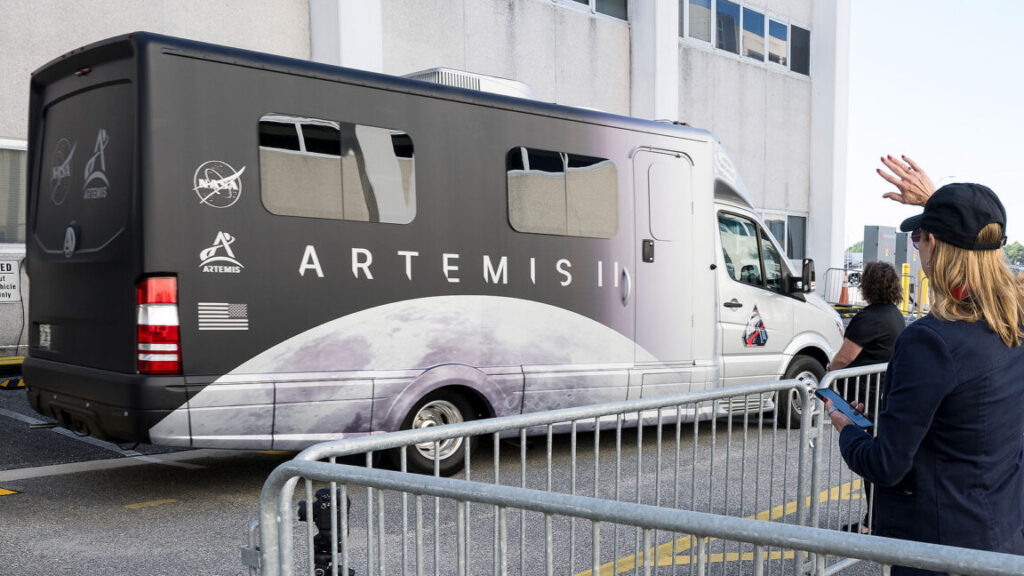
Artemis II, meet Astrovan II. NASA’s first astronauts who will fly by the moon in more than 50 years participated in a practice launch countdown on Saturday (December 20), including taking their first trip on a transport vehicle steeped in almost the entire span of US space history—from Apollo through to the ongoing commercial crew program. Artemis II commander Reid Wiseman, pilot Victor Glover, and mission specialist Christina Koch (all with NASA) and mission specialist Jeremy Hansen, an astronaut with the Canadian Space Agency, began the rehearsal at the Kennedy Space Center in Florida, proceeding as they will when they are ready to fly next year (the Artemis II launch is slated for no earlier than the first week of February and no later than April 2026). Parked outside of their crew quarters and suit-up room was their ride to their rocket, “Astrovan II,” a modified Airstream motorhome. The almost 25-foot-long (8-meter) crew transport vehicle (CTV) was custom-wrapped with graphics depicting the moon, the Artemis II mission patch, and program insignia. From Canoo to coach Airstream’s Atlas Touring Coach, though, was not originally planned as NASA’s Artemis CTV. In July 2023, NASA took delivery of three fully electric vans from Canoo Technologies after the company, a startup based in Torrance, California, was awarded the contract the year before. At the time, NASA touted its selection as focusing on the “crews’ safety and comfort on the way to the [launch] pad.” Six months later, Canoo filed for bankruptcy, and NASA ceased active use of the electric vans, citing a lack of support for its mission requirements. Instead, the agency turned to another of its commercial partners, Boeing, which had its own CTV but no astronauts at present to use it.
Continue reading the complete article on the original source