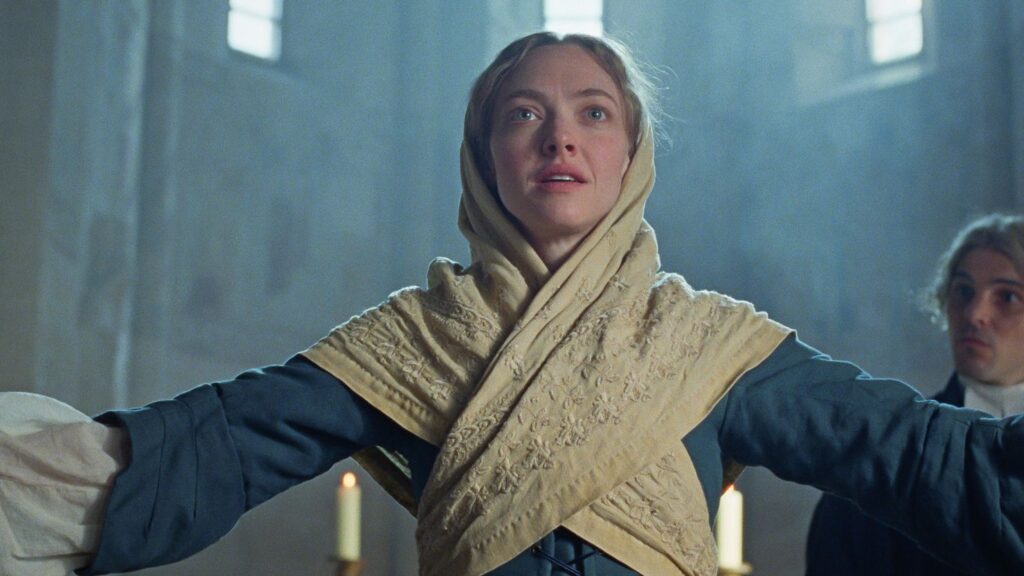
In “The Testament of Ann Lee,” two young Shakers, disciples of revolutionary preacher Mother Ann’s teachings, fail to obey their leader’s primary command: Celibacy. Fresh-faced and newly in love, with not much else to look forward to in a dark, gloomy 18th century New York City, the pair sneak off into a wooden outhouse and commit their religion’s holy sin. Their prophet, the woman who brought Shakerism from Manchester, England all the way to the American colonies in 1774, played by Amanda Seyfried, learns of the insubordination. There is no flagellation, no words of fury or punishment. Just a calm instruction that the young couple must now leave her burgeoning church. “I’m very interested in that,” said the film’s director Mona Fastvold in a video call from Los Angeles. “Can you lead without ego? Can you lead without fear or intimidation?”
Ann Lee was born in 1736 and led the Shakers, a splinter Christian group that preached egalitarianism, communal living and celibacy, until her death in 1784 at age 48. The religious sect at one point had 6,000 followers. (Today, there are three registered Shakers in the US, with one person joining this summer).
They believed Lee was the second coming of Christ — a radical thought in the 1700s, not least because at that time in history “a lot of men valued their horse more than they valued their wife,” Fastvold said. The Norwegian director stumbled upon Lee’s story while working on her second film, the historical drama “The World to Come,” a lesbian romance in the American frontier during the 19th century. Fastvold assumed lessons on Lee and the Shakers were taught in US schools as part of the curriculum — or at least common knowledge for most Americans — considering the rarity of a proto-feminist leader during that period. Once she realized no one around her had a clue who Lee was, she quickly set about planning how she could make the film.
Which is no small feat. Earlier this month, Kristen Stewart, who like Fastvold began her career as an actor but now also directs, told the New York Times she feels the industry is a “capitalist hell” with a penchant for sidelining female-centered stories in favor of big-budget studio movies. Did Fastvold agree with Stewart’s condemnation? “I did have a long conversation with her about it as well,” she said. “It is incredibly challenging to make these kinds of films.” Fastvold’s is an amorphous part musical, part historical epic that is a “cradle to grave” retelling of Lee’s life founding the off-shoot religious community, which also maps the journey of the Shakers from the UK to the US. It was entirely independently funded, and Fastvold, along with her partner, “The Brutalist” director Brady Corbet and producer Andrew Morrison, raised money incrementally — starting production as soon as they had enough people on board and building momentum from there. “Which is a very stressful way of doing it,” she said. “Plus, it’s a period piece and it’s a musical and it’s a biopic, which are the three things you’re not supposed to do in Hollywood.”
Speaking at a screening of the film in London, Seyfried admitted to “not understanding” what it was they were making at times. But “it’s impossible not to trust her,” she said of Fastvold. In terms of tackling Lee as a character, the technicality of an 18th century Mancunian accent, as well as playing someone who was born almost 300 years ago “was terrifying,” Seyfried said. “And that terror was attractive to me.”
Continue reading the complete article on the original source