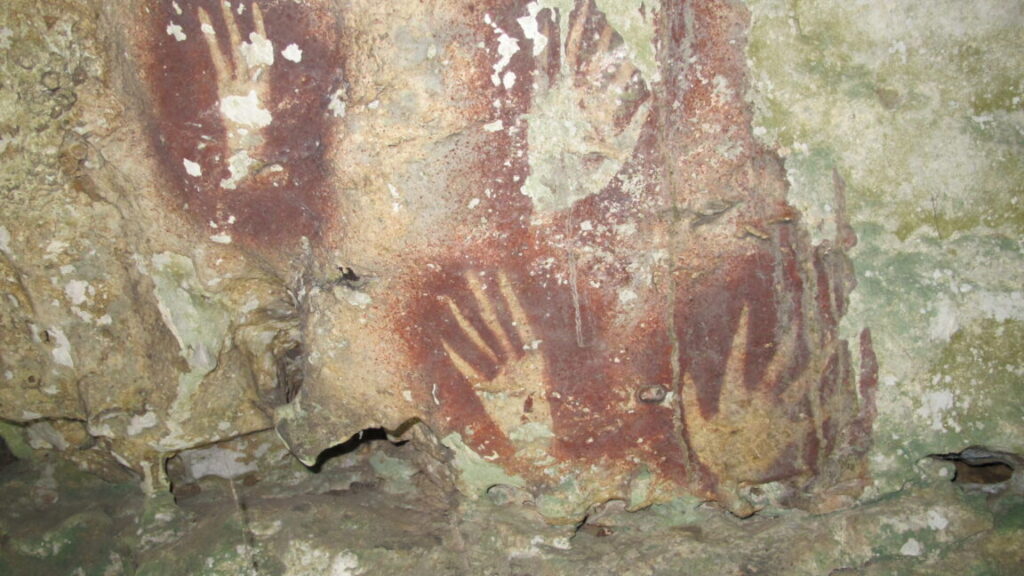
The world’s oldest surviving rock art is a faded outline of a hand on an Indonesian cave wall, left 67,800 years ago. On a tiny island just off the coast of Sulawesi (a much larger island in Indonesia), a cave wall bears the stenciled outline of a person’s hand—and it’s at least 67,800 years old, according to a recent study. The hand stencil is now the world’s oldest work of art (at least until archaeologists find something even older), as well as the oldest evidence of our species on any of the islands that stretch between continental Asia and Australia. Adhi Oktaviana examines a slightly more recent hand stencil on the wall of Liang Metanduno. Credit: Oktaviana et al. 2026 Hands reaching out from the past Archaeologist Adhi Agus Oktaviana, of Indonesia’s National Research and Innovation Agency, and his colleagues have spent the last six years surveying 44 rock art sites, mostly caves, on Sulawesi’s southeastern peninsula and the handful of tiny “satellite islands” off its coast. They found 14 previously undocumented sites and used rock formations to date 11 individual pieces of rock art in eight caves—including the oldest human artwork discovered so far. About 67,800 years ago, someone stood in the darkness of Liang Metanduno and placed their hand flat against the limestone wall. They, or maybe a friend, then blew a mixture of pigment and water onto the wall, covering and surrounding their hand. When they pulled their hand carefully away from the rock, careful not to disturb the still-wet paint, they left behind a crisp outline of their palm and fingers, haloed by a cloud of deep red. The result is basically the negative of a handprint, and it’s a visceral, tangible link to the past. Someone once laid their hand on the cave wall right here, and you can still see its outline like a lingering ghost, reaching out from the other side of the rock. If you weren’t worried about damaging the already faded and fragile image, you could lay your hand in the same spot and meet them halfway.
Continue reading the complete article on the original source