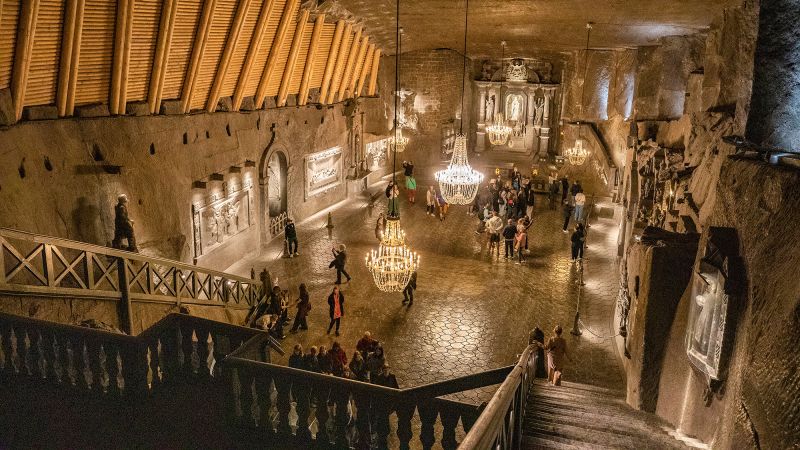
Down at the bottom of 380 dizzying steps, the walls are an imperfect gray. They look like rock — but they taste salty. How do visitors know? They’re encouraged to lick them.
Just to the southeast of Krakow, Poland’s second-largest city, lies the underground realm of the Wieliczka Salt Mine — part cathedral, part industrial relic, part theme park.
Every day, up to 9,000 visitors descend into the mine, which was declared a UNESCO World Heritage Site in 1978. Salt production at Wieliczka ended in 1996. But after 700 years of operation, and more than 150 miles of tunnels chiseled underground, it lives on as a tourist attraction.
Over the centuries, miners at Wieliczka created nine levels of tunnels and chambers reaching 1,073 feet — nearly 330 meters — below the surface. Today, around 2% of what they created remains open to the public. Even that fraction is impressive.
Accompanied by guides, visitors can walk the classic tourist route — just over two miles in about two hours — or opt for the “miners’ route.” On the three-hour adventure, they’re given a headlamp, helmet and emergency carbon monoxide absorber.
Continue reading the complete article on the original source