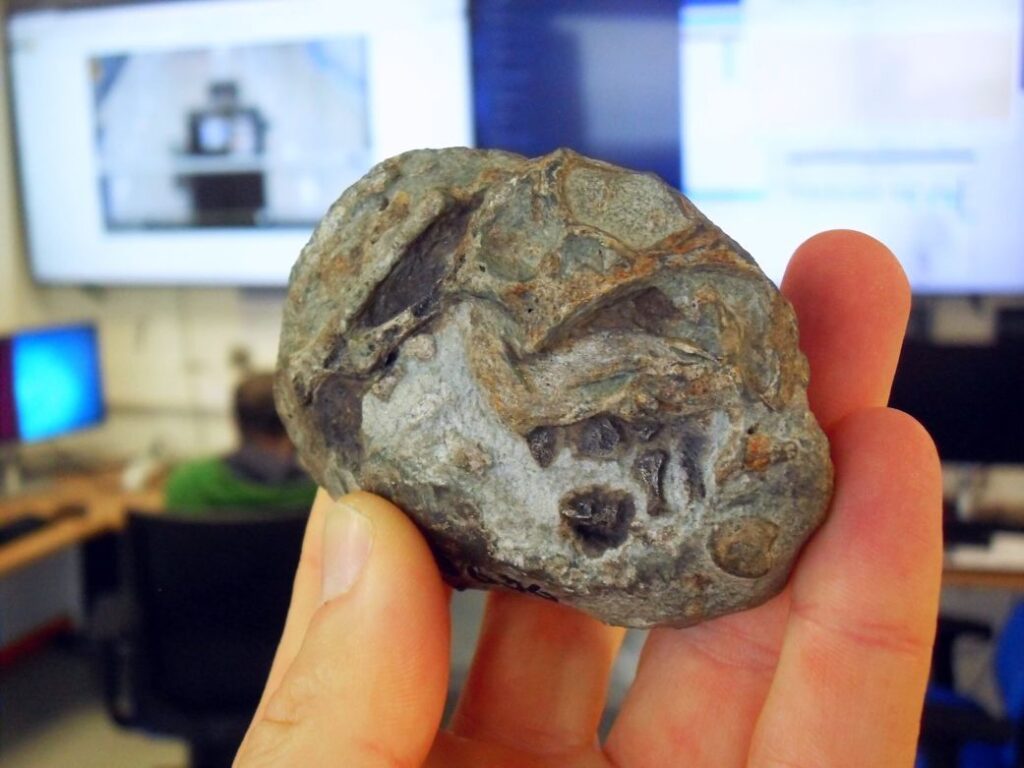
Researchers studying a 250-million-year-old fossil have found the first ever proof that mammal ancestors laid eggs, with the discovery also shedding light on a remarkable survival story.
The fossil, found in South Africa, belongs to a tightly curled embryo of a Lystrosaurus, a mammal ancestor famous for surviving an extinction event 252 million years ago known as the “Great Dying,” according to a study published in the journal PLOS One on Thursday.
A team of researchers scanned the fossil using high-resolution computer tomography and a synchrotron, which produces X-rays that are brighter than the sun, and found that the Lystrosaurus embryo’s jaws were not completely fused.
This trait, which is only found in the embryos of modern birds and turtles, proves that the Lystrosaurus embryo had been inside an egg when it died, study lead author Julien Benoit, an associate professor at the Evolutionary Studies Institute of the University of the Witwatersrand, South Africa, told CNN.
“This is the first time we can say, with confidence, that mammal ancestors like Lystrosaurus laid eggs, making it a true milestone in the field,” said Benoit.
Continue reading the complete article on the original source