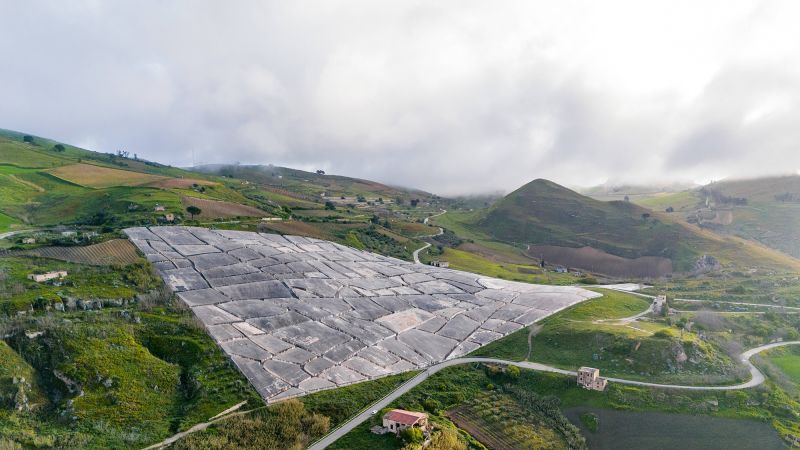
Sicily’s landscapes are a mix of dreamy coastline, rugged peaks and rolling hills that are every bit as spectacular as those in Tuscany.
But in the far west of the Mediterranean’s largest island, amid the undulating landscape of the Belice Valley, lie two hillsides that could never be mistaken for Tuscany. On one stand columns and walls that, from a distance, could be Greek or Roman remains, but up close become recognizable as the ruins of more modern buildings.
The next hill over, meanwhile, is the color of concrete. It’s not an experimental crop growing there — get closer and you see there’s nothing swaying in the breeze. Closer still, you realize that this is because it is literally concrete, poured over the hillside in a polygon shape — a gray blanket swaddling the green.
Visible for miles around, and originally a shocking white when it was completed in 2015, this is the “Cretto di Burri,” or the “Grande Cretto” (the great cleft, or crevice). A vast work of land art, it is made of concrete poured over 926,000 square feet of the hillside. This isn’t art for the sake of it. The Cretto sprawls over the remains of the town of Gibellina, which was destroyed in an earthquake on January 15, 1968.
While other villages destroyed by the earthquake still stand in ruins, Gibellina is a town turned to stone. Channels cut through the concrete represent the streets that once ran underneath. Visitors can walk along these “streets” where the concrete wedges — each representing a block of the town — stand shoulder-to-head height. Sometimes, a swell in the concrete indicates ruins below that were bigger than average, or were harder to clear.
Continue reading the complete article on the original source