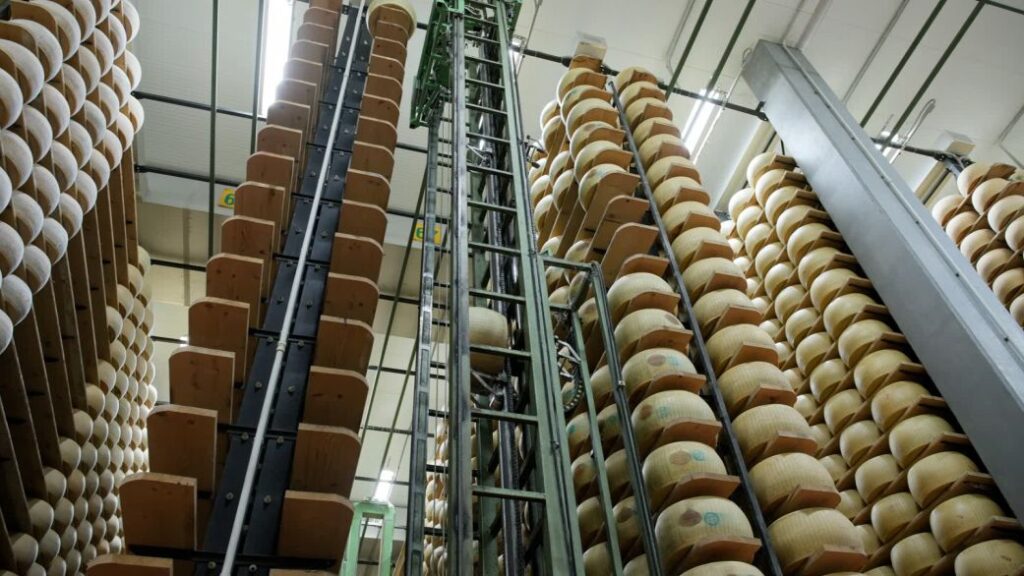
In the heart of Emilia‑Romagna, northern Italy, vast climate‑controlled warehouses hide one of the country’s most valuable assets. Towering shelves hold hundreds of thousands of wheels of Parmigiano Reggiano aging slowly, quietly and becoming more valuable with every passing month.
To outsiders, it looks like a cathedral of cheese. To Italy’s dairy producers, it is a lifeline.
Parmigiano Reggiano is one of the world’s most tightly regulated foods. It can only be produced in a small, designated area using three ingredients — milk, salt and rennet — and it must age for at least 12 months before it can be sold. Many wheels mature for 24, 36, or even 40 months.
That long wait creates a financial bottleneck. Farmers must be paid every 30 days. Staff, feed and energy costs accumulate daily. But revenue doesn’t arrive for a year or more. For more than a century, Credem Bank has stepped in to bridge that gap — accepting cheese as collateral.
Giancarlo Ravanetti, the boss of the bank’s cheese warehouse business, explains: “In Italy about 4 million wheels of Parmigiano Reggiano are made, and we keep 500,000… and allow customers to use the wheels as collateral to obtain financing.” The warehouse handles “about 2,300,000 wheels a year,” he adds. Inside these vaults, the value is staggering: “About 325 million euros ($382 million) worth of Parmigiano Reggiano.”
Continue reading the complete article on the original source