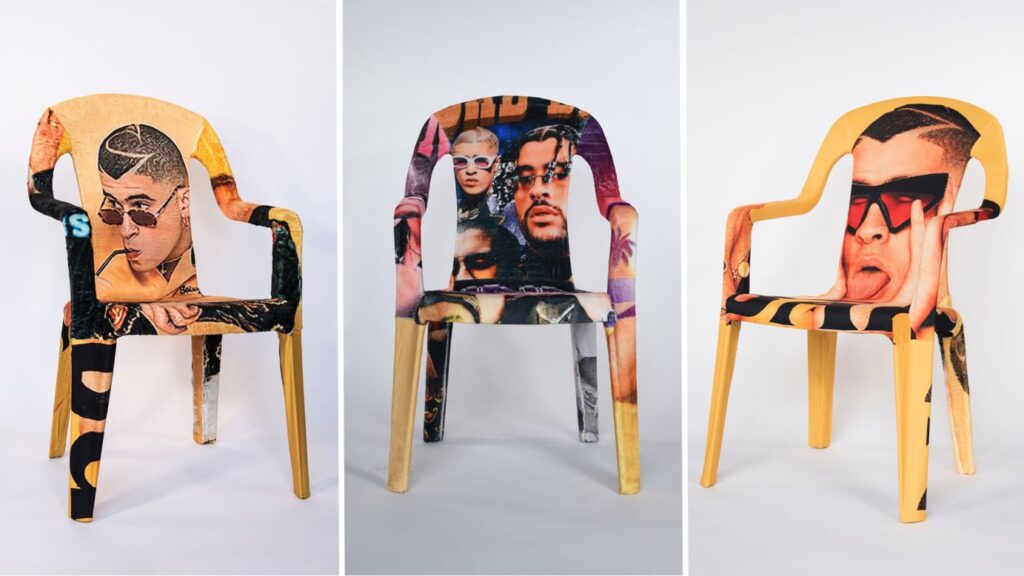
Generally speaking, you can’t sit on the art in a museum. But in one gallery of the Museum of Contemporary Art Chicago — which is currently staged to resemble a karaoke bar complete with a disco ball, stage and jukebox — three plastic chairs, upholstered with the face of Puerto Rican superstar Bad Bunny, are waiting for you to rest between songs.
Part of the exhibition “Dancing the Revolution: From Dancehall to Reggaetón,” the chairs are the work of the artist Edra Soto, who transforms the objects of her childhood and the everyday design and architecture found in Puerto Rico into artworks and spaces that evoke life on the small island. She’s mounted flat box fans that keep families cool in the shapes of Christian crosses; interpreted the colorful ubiquitous ironwork fences that demarcate home and street into towering sculptures; and placed tiny keyholes in her sculptures that reveal quiet photos of Puerto Rican houses inside.
“All these objects are rooted in the home,” she said in a video call from her home in Chicago, explaining that she is always thinking about them “in a way that is higher than their assigned function.”
Together, her works often create contemplative spaces, and lately, she’s delved more into the spiritual, with her own Catholic upbringing influencing the “tabernacle-like” atrium that is central to her current show at the Kemper Museum of Contemporary Art in Kansas City, as well as her newest exhibition at the Museo de Arte de Puerto Rico.
Her series of Bad Bunny chairs, then, or “BB chairs,” made over the past year and a half, are perhaps representative of a different kind of devotion as the Puerto Rican singer has reached staggering new levels of fame. (His 2022 album “Un Verano Sin Ti” is the highest streamed album in Spotify’s 20-year history.) In “Dancing the Revolution,” he makes multiple appearances in the show, which is dedicated to the visual history and political power of Caribbean music and dance. The exhibition came to be in the wake of the summer of 2019, when mass protests over years of government corruption led to the resignation of Governor Ricardo Rosselló —demonstrations in which Bad Bunny became a central figure as he paused his tour to join the movement. In one monumental photograph in the exhibition, he stands tall above the crowd in San Juan waving the Puerto Rican flag, reminiscent of Delacroix’s “Liberty Leading the People,” curator Carla Acevedo-Yates explained during an exhibition walkthrough.
Continue reading the complete article on the original source