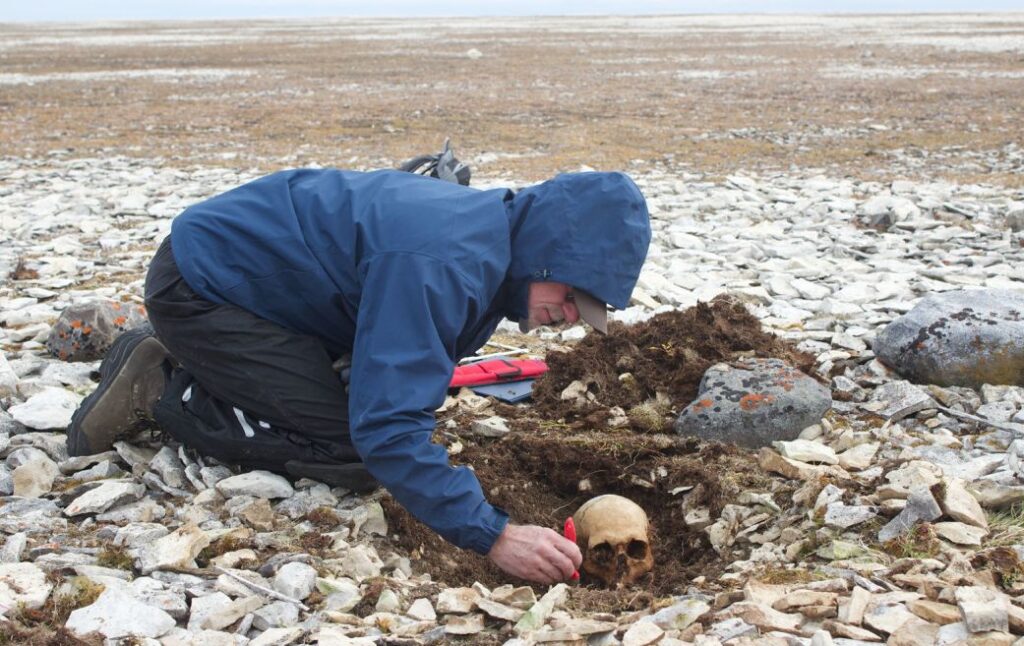
Researchers have identified the remains of four members of a doomed 19th century expedition in the Arctic by matching DNA to the sailors’ living descendants — and solved a case of mistaken identity along the way.
The four sailors were part of Sir John Franklin’s 1845 expedition to find the Northwest Passage, a sea route north of the Canadian mainland and Arctic Circle that connects the Atlantic and Pacific oceans via the Arctic Ocean. British naval officials, merchants and polar explorers prized unlocking the passage because it would provide a shorter trade route between Europe and Asia.
The expedition’s two ships, the HMS Erebus and the HMS Terror, were carrying 129 crew members when the vessels became trapped in Arctic ice for nearly two years before crews deserted them in April 1848. The remaining 105 men dragged sledges of supplies overland along the west coast of King William Island, in what’s now the territory of Nunavut in Canada, but none survived.
The expedition buried only three members — those who died during the first year — with identifying headstones. Rescue teams and later various researchers in the years since have uncovered artifacts and remains scattered across the island and the Adelaide Peninsula. However, connecting bone fragments to individual crew members has proved difficult.
Within the past few years, matches with DNA from descendants helped scientists identify John Gregory, the engineer aboard the Erebus, as well as James Fitzjames, the ship’s captain — whose bones show evidence of cannibalism.
Continue reading the complete article on the original source