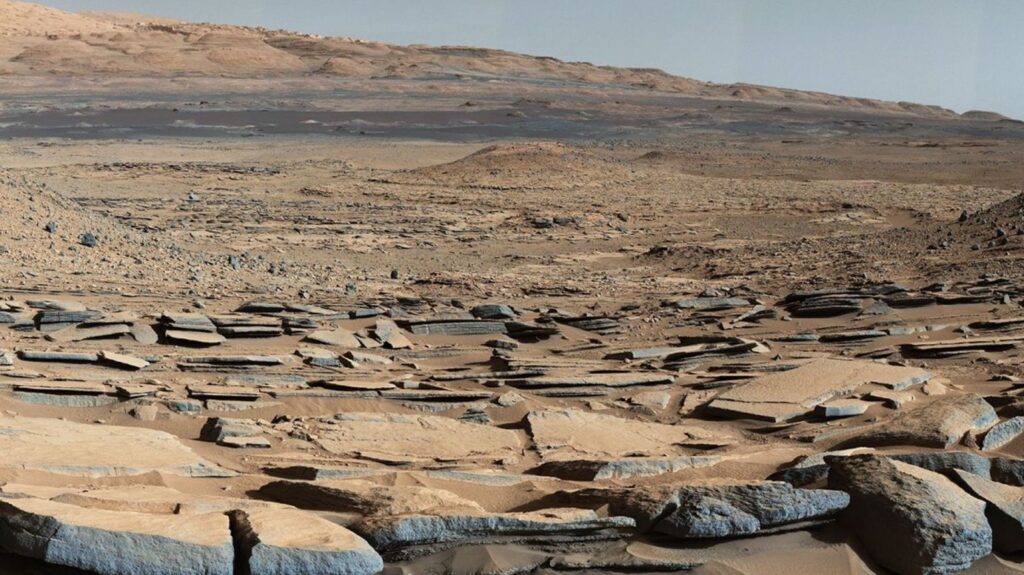
Mars may have once had an ocean so vast that it covered one-third of the planet before evaporating billions of years ago and leaving behind a telltale sign: a flat band of land, outlining the former ocean — similar to the ring left behind in a drained bathtub.
If confirmed by direct observations, this “coastal shelf,” as researchers call it, would contribute crucial evidence to a long-standing scientific debate, according to a study describing the new evidence. While dried-up river networks, deltas and lakebeds offer proof that Mars had a watery past, there is no consensus among experts on whether it also had a large ocean, which would have made Mars look much more similar to Earth than it does today.
“The question is: If there was an ocean on Mars and it dried up, what signs would it have left?” said Michael Lamb, senior author of the study published last week in the journal Nature. “What we’ve looked for is a band that would wrap around where the shoreline would have been, like a flat bench — because that’s essentially what we see on Earth, which we know as the continental shelf.”
Lamb, a professor of geology at the California Institute of Technology, and lead author Abdallah Zaki, a distinguished postdoctoral researcher at the University of Texas at Austin, ran computer simulations to dry up the oceans on Earth and see what geological traces they would leave behind. The continental shelf emerged as the most distinct feature, enduring through time and changing sea levels.
The research team then searched for an analog on Mars using data from NASA’s Mars Orbiter Laser Altimeter or MOLA, a probe that mapped the planet’s surface features from orbit using laser. “We looked for a similar feature on Mars and found some evidence that it could be there,” Lamb said. “It doesn’t look exactly like the continental shelf on Earth, however, so there’s some evidence in support of it, but not all the pieces of the puzzle.”
Continue reading the complete article on the original source